Life With AI, Episode 2: Michael Sharpe on Building a One-Man AI Recruitment Practice
Michael Sharpe, Founder, Manoeuvre (recruitment & career coaching, Auckland)
This is the second in a series where I ask people the same handful of questions about how AI actually shows up in their work, not the highlight reel, just what’s actually happening day to day.
My guest is Michael Sharpe, founder of Manoeuvre, an Auckland recruitment and career coaching practice. Michael spent 16 years in recruitment with Hays and Robert Walters, the last four years placing chartered accountants, before peak migration and peak interest rates hit the market hard and cost him his job. With two young kids needing school drop-offs and pick-ups, and no appetite to jump straight back into another corporate recruitment role, he went out on his own. He now runs Manoeuvre solo, placing candidates, coaching job seekers on how to position themselves, and building his own AI tools to do the work a whole back-office team used to handle. Find him on LinkedIn.
In short: Michael built himself a one-man AI-powered back office. A Gemini chatbot reformats CVs into branded, professional documents, work that used to take a person all day. A pair of Gemini gems handle business development research and CV writing. And a bio-builder tool on his website, coded entirely by AI even though he can’t code, turns coaching answers into a positioning statement backed by a real example. His biggest lesson: it hallucinates when his own prompts are vague, not when the tool is broken. None of it has made the recruitment market itself any less patchy, and he’s candid about that. Looking further out, he’s less worried about AI replacing jobs than about New Zealand missing the upside altogether, watching another wave of local tech get sold offshore before it ever reaches real scale at home.
Tell me a bit about yourself and what you’re doing these days. How did you get to where you are, and what does day to day look like?
I spent close to 16 years in recruitment with Hays and Robert Walters, the last four years placing chartered accountants. Then 2024 hit. Peak migration, peak interest rates, a lot of economic headwinds, and on top of that AI made it easier for anyone to write a great CV and hit apply, so applications exploded and recruitment got hyper competitive. A lot of the accountants I placed had come in on that migration wave, and once the market cooled, the hiring dried up fast. It hit me hard. Each time I’ve lost a role, it’s been a chance to ask whether I actually want to jump straight back into another corporate recruitment job in a hard market. I’ve got a nine-year-old and a 13-year-old, so I’m doing school drop-offs and pick-ups now, which makes a full-time job difficult anyway. I’d also always wanted to build my own brand and figure out my own value proposition, so I went out on my own.
AI has basically been my colleague through that. It started with something simple. In a recruitment team you’d normally have people whose whole job was reformatting CVs into a branded, unified document with your notes at the top. I built a chatbot that takes something that looks like anything and turns it into a clean, professional format, at no cost, work that used to take someone all day, every day. I use Google Workspace, so mainly Gemini, and I taught myself Canva at the same time, which was completely new to me. Fonts, sizes, colours, structure, so that even though it’s just me sitting at my desk at home, externally I can appear better than I really am, similar to the bigger firms out there.
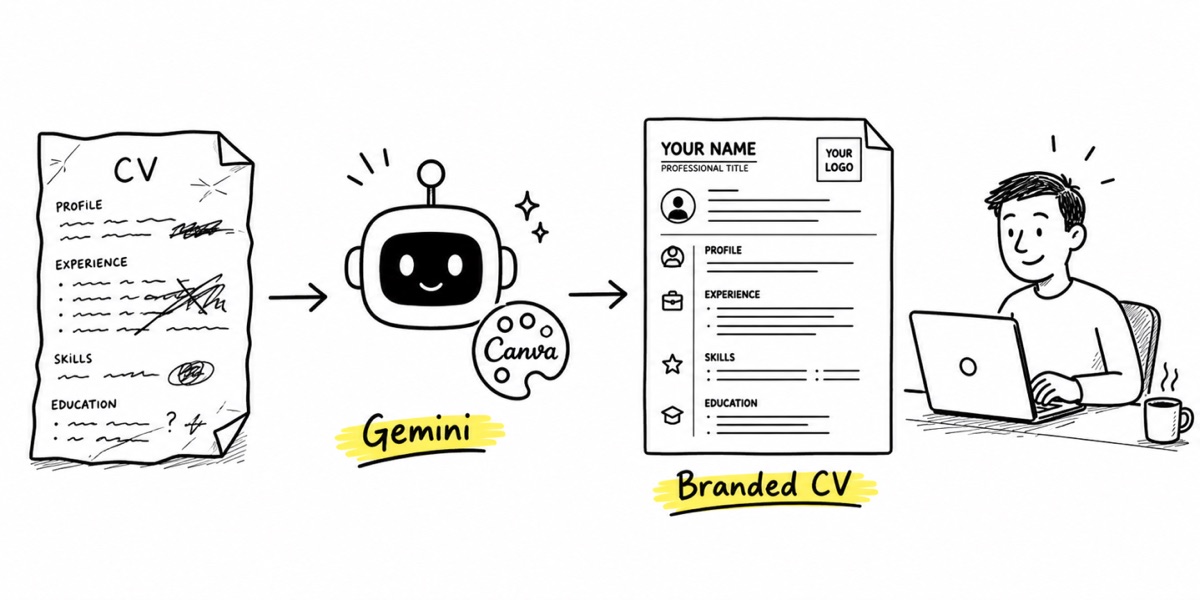
From there I built out a couple of Gemini gems. One does business development research. If I meet someone like you, the obvious move is to introduce you to the two people I already know, but there might be ten real options in the market who’d want to hire you. The gem helps me work through someone’s industry background and skill set to find the other eight. Another is basically a CV writer bot. I drag and drop a PDF and it spits out a formatted document with my branding on it.
Because recruitment income is lumpy, I’ve also been building a coaching offer, charging candidates by the hour rather than only getting paid on placements. What I’ve noticed is people are bad at articulating what they’re good at. A recruiter calling a client about a candidate is really just giving an elevator pitch: what they’ve done, what they want to do, why you’d want to meet them. So I built a bio-builder on my website, a set of coaching questions that generates a positioning statement, a claim backed by a specific example and a reference who can back it up. CVs almost never have that. I’d never be able to do it in a million years if it wasn’t for AI. I could come up with the question, think through the logic of how you get someone to write a better positioning statement, but I’d never have had the skills to put something on a website with input fields that generates text on the page. I needed AI to write the code blocks.
Do you remember your first use of AI?
It was around the time everyone’s writing started sounding a bit too polished and someone flagged that to me. We started playing with it, and it was the kind of thing you’d normally put into a Google search bar, except instead of a list of websites, you’d get a whole essay back. People used to come to me assuming I knew everything, so I started saying, why don’t we just put that question to this thing instead, it’s got more knowledge than me and it’ll explain it more clearly. I actually enjoy writing, I keep a journal, but most people in recruitment don’t. They’re glorified phone reps, they don’t want to write a job ad, so being able to say “write me a job ad for this” and have it come back done was a genuine relief for a lot of them. Their logic was, that’s one less thing eating our time, so we can get back on the phone. Mine was more that this industry could do with a bit more craftsperson mentality and a bit less call-centre mentality. But that’s the industry.
Was there a bridge moment, a point where the capability just clicked, or was it more a steady one-step-at-a-time thing?
It’s a bit like any addiction. Someone slightly ahead of you shows you something and you want to be as switched on as them. I remember seeing people post prompts like “act as a strategic consultant who’s scaled multiple billion-dollar companies, give me hard truths, tell me how to grow a billion-dollar company,” and it would come back at you almost like a bully, don’t give me excuses, why didn’t you do this. It ended up being the most proactive boss I’ve ever had. So a lot of it was watching people one step ahead of me and trying things myself.
You do waste a lot of time with it too. Holy smokes, you can look up after going super deep into something for an hour and think, what did I actually achieve there? But the one benefit is you’re learning. I get properly frustrated with it as well. I’ve got a Gemini gem set up for my business, one bot just for recruitment conversations, one just for coaching, so we stay on task. The idea was if I get someone into a coaching session, the bot and I have trained together well enough to add real value, using the Google Meet transcript to pull out good stories as we go and get them written up properly. But because both bots live inside the same project, the recruitment one started dragging in coaching context, going back to strategy documents I’d set up three months earlier instead of what we were actually talking about. I’d be sitting there going, no, no, you idiot, and I genuinely don’t know how to manage that yet. I’ve started telling it to answer me in 200 words or less and stick to the direct question, otherwise it’ll just hand me a strategic blueprint and quarterly objectives when I only asked for one thing.
Has there been a time it didn’t work?
What I’ve found is it hallucinates when I haven’t been completely clear. If it doesn’t quite understand what I’m asking in that one prompt, it defaults back to “here’s our strategic objectives,” or answers a question I asked weeks ago instead of what’s actually in front of it. But if I go back and say “try again,” or push it in the next response, it usually corrects and picks up the current thread. So it’s really a lesson in being clear about exactly what I want the machine to do, not a fault in the tool itself.
Where else has AI worked into how you operate?
I’ve also started using it for interview-style calls, podcast style, with people in coaching or recruitment. I’ve done about four episodes. I use a platform that lets you edit a long transcript directly, cut filler words, switch camera angles, it’s got a genuinely good AI engine built in for that. I wouldn’t use Claude or Gemini for the video editing itself, it’s more of a companion for planning and cleanup.
The strange thing is I can be working alone all week, and because I’m talking to AI throughout it, I never actually feel lonely, even though I’m alone the whole time. That’s a bit unsettling if you project it out five or ten years, everyone on their screens instead of going out.
Where do you think this goes, medium to long term? Do you think AI can help with relationship and belonging needs?
There’s a real philosophical question there about whether that’s good or bad. Loneliness is a killer, and it usually comes from not feeling listened to. You can be in a crowded room and still feel it if no one’s really holding space for you. Humans are flawed at that, we’re all stuck in our own heads. AI has infinite patience, so it can trick you out of feeling lonely, but it also does things like tell me I’ve done enough for the day, go pick up your daughter, which I actually like that it’s built in.
I think too much screen time is the real problem, not AI itself. You feel better after a walk in the park regardless. Social media is built to keep you engaged on the phone for its own sake. AI, so far, has told me to go spend time with my family on the weekend, and gets noticeably shorter with me when I do. I think it’s got real potential to be positive for people psychologically, because it gets to know you well enough to notice when you’re starting to wobble. But I’m wary of any technology whose commercial goal is just to keep you engaged with the technology, that’s not going to be good for humanity long term. Online should enable offline, not replace it, because the real relationships and the real wellbeing come from community, nature and contribution.
If it’s helping me look like a professional operation I couldn’t otherwise afford, a graphic designer, an administrator, then great. If it’s just distracting me and keeping me engaged in an AI world without helping my actual commercial or personal goals, then it’s a weapon of mass distraction, same as social media.
What worries me more is job displacement, specifically here in New Zealand. None of the big AI companies are based here, so are we just an economy that pays subscriptions offshore without any of that money flowing back in? We’ve been running on property speculation for three decades, and we need a real technology sector generating foreign exchange for the country. I keep waiting for local leaders to actually get it. We’ve got the Technology Investment Network, Icehouse Ventures, university incubators, but our tech companies tend to grow to a certain size and then get sold offshore before they hit the scale that would actually move the needle here. We never quite get our own version of that as a backbone for the country, and I haven’t seen it show up yet from our politicians or business leaders.
You and I are massively enabled by this, if you think of it less as a jobs market and more as an opening for self-employment, people making their own money without relying on one organisation. But most people aren’t set up like that. Early adopters like us need this to actually pay off, because if we’re just at home playing with AI tools and it’s not turning into money, that’s a hard place to be long term.
There’s a gap right now between what people want to do and how they actually get there, and that gap is an opportunity, even if it’s shrinking. You might not end up with just one venture either, it might turn into a couple, starting as something you’re passionate about on the side. I started filming my boys playing rugby. I wore out a phone a year doing it, so I bought a proper camera. Team mates asked for copies, I put it on YouTube, people started asking for clips, and it’s turned into an account doing something like 250k views a month across Instagram, TikTok and Facebook. Should I have branded crocs now?
It’s interesting, because I’m quite prolific on things like LinkedIn, there’s a lot of AI content on there. I write thoughtful stuff and get no views. I think it’s because I’m talking about life-changing recruitment content, and I’m one of millions of recruiters on LinkedIn posting the same shit. It’s not actually a passion, it’s me hustling, it’s work. Whereas you filming your son’s rugby is genuinely something you’d be there for anyway, because you’re their dad. You’ve got a real passion there and you’re sharing it, and people are way more drawn on the internet to someone following their nose towards their actual passion than they are to me talking about work. I get nowhere near 100,000 views, I’ll tell you that.
To be honest, this was always something I wanted to scratch. When I was in recruitment I was talking to marketers all day, I studied marketing myself, and I always wanted to build my own brand and develop the skills, video, graphics, storytelling, that I never got to use in an agency job because that was always someone else’s department overseas, treated like an admin burden rather than creative expression. So I’ve enjoyed building this. It’s just been too patchy for my liking. There was a little bit of positivity in February before Trump started bombing around again, and it hasn’t really returned. I’m in this weird dynamic where clients are asking me to find people, but people aren’t looking, so I’m doing outreach every day and it feels like I’m working without getting paid for it, which is the hardest part. You only need a couple of deals to get the ball rolling, but it’s been nothing, nothing, nothing, one, nothing, nothing, one, and right now I’m just waiting for the next deal to drop.
Do you follow the Moonshots stuff, Peter Diamandis, Singularity University, all that Silicon Valley talk about a coming abundance? Electricity dirt cheap, nobody owning cars because there’s a robotaxi everywhere and it’s basically free since there’s no driver, that kind of thing. I want that bit to actually arrive, because right now it feels like we’re at the stage where we’ve got the AI layer and all the bad stuff that comes with it, but I don’t know when the good stuff shows up after. Maybe next time we’re all in our own businesses, houses paid off, all that.
There’ll be a three million dollar average home in Auckland by then, though.
Yeah, three million dollar average homes in Auckland, but average wages are still about 69k.
Michael's CV bot and BD research gem are what AI Operations work looks like in practice for a solo operator: pick the slow manual step and build a tool that actually does it, not a chatbot pointed at everything.